
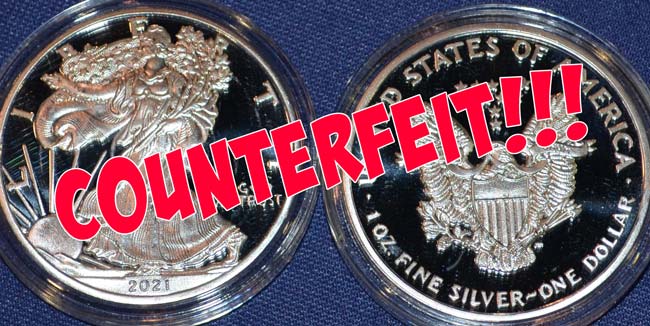

Buyer Beware
Counterfeiting has been a problem since the concept of money came about and persists to our day. More than just money is counterfeited; designer goods, documents, medicines, jewelry, personal care products, food, watches, accessories and on and on. These products designed to impersonate the originals can be harmful to your health with untested ingredients and quite often ineffective to the malady they are meant to relieve.
Fake Money
What follows is a public service announcement put out by the FBI in 2021:

The FBI Warns the Public of Counterfeit Coin Scams
The FBI and the Department of Treasury are warning the public that counterfeit coins are being sold on various online auction, social media and retail websites, targeting investors and collectors. There are three types of counterfeit coins: transactional coins (quarters, dimes, etc.), numismatics (high value collectables), and bullion (precious metals). Online advertisements used by scammers claim the coins are authentic; however, consumers are receiving fake coins and precious metals.
Online estimates reveal that consumers spend millions of dollars buying valuable or rare coins, but most receive near-worthless foreign-made counterfeits. An increasing number of counterfeit coins are being seized at US ports-of-entry. For example, in April 2021, U.S. Customs and Border Protection (CBP) officers at Chicago’s international mail facility seized 279 shipments from China containing counterfeit coins and currency. In 2020, CBP seized over $1.64 million in counterfeit cash and coins at Chicago O’Hare International Airport.
Scammers capitalized on the financial uncertainty and nation-wide coin shortage brought on by the COVID-19 pandemic to take advantage of amateur investors online. Many victims find purchasing online an easy method to make investments, as they can easily find what they are looking for, pay cheaper prices and have their investments delivered right to their door. Do not let online scammers rob you of your investment. Protect your wallet and your personal data by purchasing from reputable, registered coin dealers. If you decide to purchase outside this venue, ensure that the coins are tested by a certified organization, before making a purchase.
The FBI reminds readers to always research online sellers before buying coins and precious metals online. Check online reviews and Better Business Bureau complaints before making a purchase. Protect your investments by dealing with reputable companies and dealers.
If you believe that you are the victim of a counterfeit coin scheme, immediately report the activity to the online payment provider or credit card company used for the transaction. All identified Counterfeit coins involving U.S. currency should be reported to your local U.S. Secret Service office which can be found at https://www.secretservice.gov/contact/field-offices. You can also file a complaint with the U.S. Treasury Office of Inspector General at https://forms.treasury.gov/treasuryforms/Form?templateID=a1Qt00000028jF0EAI. All non-currency coins and bullion should be reported to the Anti-Counterfeiting Task Force at https://acefonline.org/counterfeit-alert/report-a-counterfeit and all cyber-related scams at the FBI’s Internet Crime Complaint Center at www.ic3.gov.
These fakes targeting collectors and are typically coins, often a particular coin or issue that is scarce and expensive. Those collectors who are inexperienced and looking for investment quality coins are the greatest victims. Millions have been lost to these frauds. One of the popular sites to list counterfeits is eBay. You can find numerous advertisements for fakes surfing for a few minutes there. They rarely get taken down. They are left to run with blatant disregard for accuracy, US law or the pockets of their victims which happen to be their customers. Consumer protection seems to be either lacking, not a priority or they lack the help needed to police the entire venue.
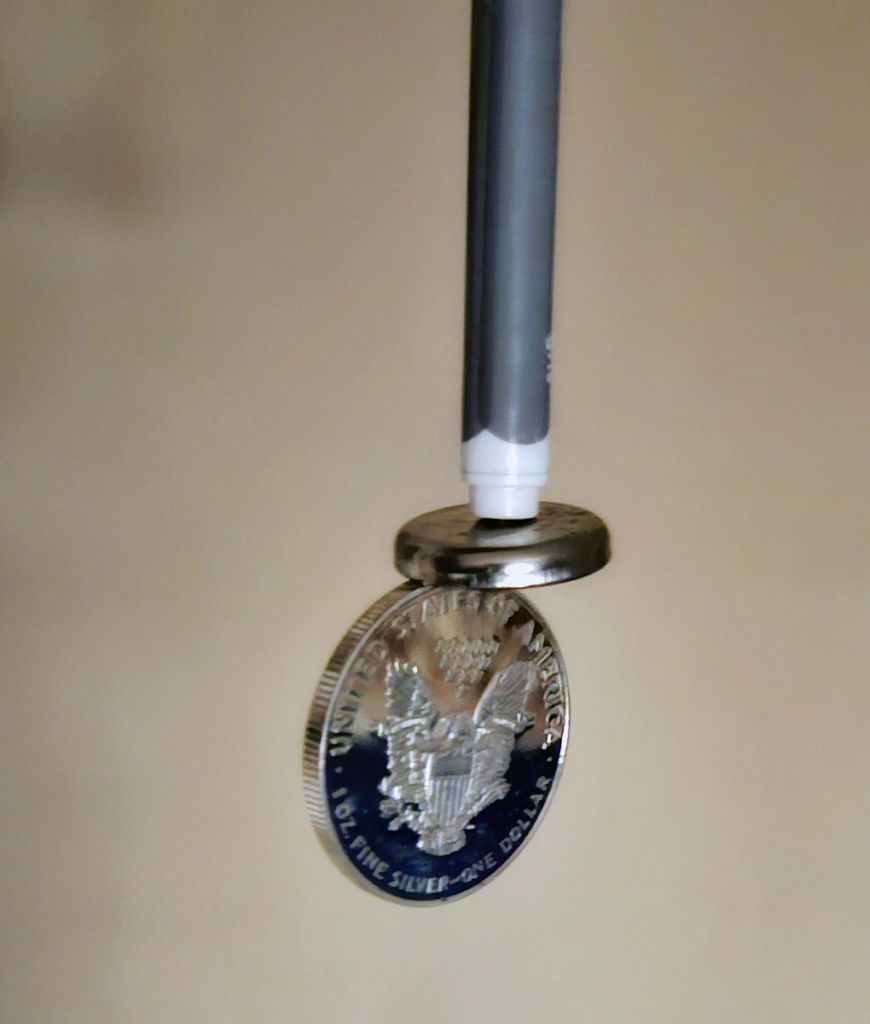
Education is the Key
Learning how to spot these seems the only protection. There are many articles written on the internet and hobby magazines to assist. A good place to start is ‘Counterfeit Detection‘ by NGC. NGC also publishes a Counterfeit Detection column in its monthly eNewsletter. The American Numismatic Society holds classes, many online, including counterfeit detection and issues a monthly magazine to members.
What to Look For
- First, always use your instincts. If it looks suspicious, follow it up with tests you can do yourself
- .Tools of the trade include a gram scale accurate to .01, a magnet, a ring test set or use a fingernail, a good 5x or 10x loupe.
- Silver or gold coins are not ferrous (magnetic). The easiest test.
- Weigh it. All US and most foreign coins have their weights published. There is a tolerance outside their normal weight but usually very small. US coin weights are listed in the Red Book. Consider wear on older coins while performing this test.
- On the subject of older coin, if a circulated coin shows too much luster, or its just too shiny it may only be cleaned but causes suspicion nevertheless. Put the loupe on it and look for cleaning signs, usually faint hairline marks all running the same direction.
- With silver a ring test vise can be used and tap an edge with a small metal device or fingernail. Or, try to hold it very lightly and tap. You’re listening for a nice ring. If a dull thud then it probably is not silver.
- Gold coins are tough and we advise to take them to a shop and ask them to test with a Sigma or whatever gold testing device they use. Many fakes made in the 1960’s and 70’s are made of gold and very difficult for an untrained eye or a machine to verify.
- When you get stuck and can not make a decision, the only outlets are your local shop or a grading company. What a disappointing surprise to find that coin you spent a paycheck on isn’t real. If you purchased from a legitimate outlet you should be able to submit a return. If not, it happens, lick your wounds and don’t give up.
.