
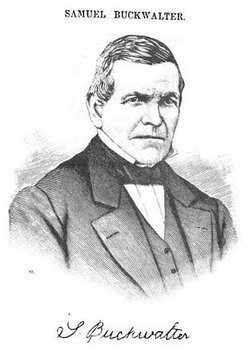
SAMUEL BUCKWALTER 1801-1869
Birth: 6 May 1801
East Nantmeal, Chester County, Pennsylvania, USA
Death: 26 Feb 1869 (aged 67)
Charlestown, Chester County, Pennsylvania, USA
Burial: Morris Cemetery
Phoenixville, Chester County, Pennsylvania, USA
Bank president and farmer
History of Chester County, Pennsylvania By John Smith Futhey, Gilbert Cope 1881
“…Of these children, Samuel, the eldest, was born May 6, 1801, in East Nantmeal township, and in 1817-18 went to Charlestown township to live with his grandfather, Johannes (John), on the farm on which John Henry Buckwalter now resides. In 1832 he was married by Rev. Jacob Wampole to Mary, daughter of Daniel and Margaret High, of Schuylkill township, by whom he had seven children, – Charles C.; John Henry; Samuel R.; Elizabeth, married to Enoch J. Davis; and Helen Caroline, all living; and two deceased, Daniel and Margaret, who died young. Samuel Buckwalter died Feb. 26, 1869, and his wife, Mary (High), Jan. 4, 1850. He was a second time married, in 1855, to Ann Pennypacker, widow of James Pennypacker. He was one of the most systematic farmers in the county, and paid special attention to feeding good stock, in which he greatly excelled, and his farm and stock were kept always in good condition he was, with his family, a member of the Mennonite Church. He served as a school director and frequently in other township offices. He was an Old-Line Whig in politics and later a pronounced Republican. He was at the time of his death president of the Bank of Phoenixville, in which he was a very large stockholder. Of his children, Charles C. lives in the neighborhood of the old homestead farm, on which resides his brother, John Henry, the popular and efficient county treasurer, elected in 1878 for a term of three years, and the remaining brother, Samuel K., is in active business at Phoenixville. He was known as a successful business man and a model farmer. Respected in the community for purity of character, he was a worthy representative of his well-known family in the county”
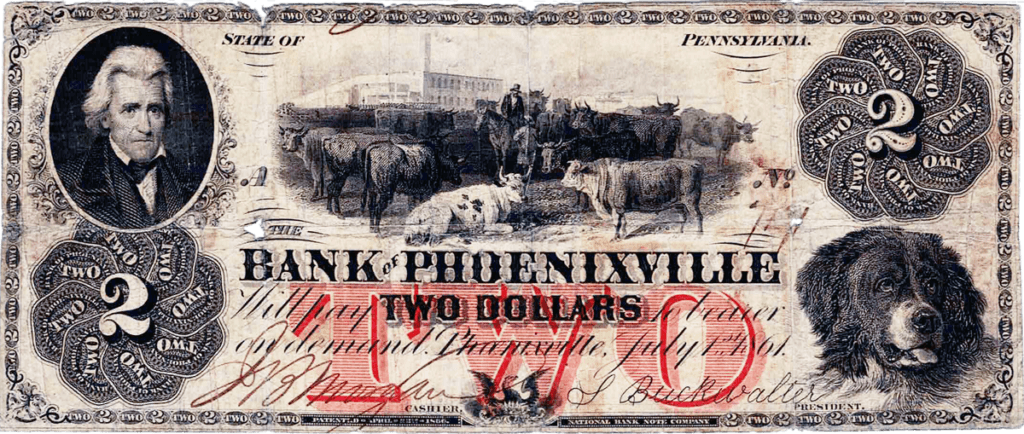
July 1, 1861 two dollar note of the Bank of Phoenixville signed by the President of the bank S. Buckwalter in the bottom right. Possibly, the serial number is 741. Much larger than today’s currency it measures 7 1/8” wide by 3” tall. Vignette at the upper left is of United States President Andrew Jackson (1829-1837), a pastoral scene center, a friendly looking dog at lower right and the large red ‘TWO’ , bottom center is an anti-counterfeiting device. The reverse is blank. Phoenixville, PA- Bank of Phoenixville – The bank was organized during 1858 and remained in business until becoming the National Bank of Phoenixville in 1864. This note sold at Heritage Auctions on May 17, 2022 for $432.00 including 20% buyer’s premium and on January 10, 2025 to the author for $600 at the Florida United Numismatists Show at the Orange County Convention Center in Orlando, Florida. It is in poor shape and grades a 12 on a scale of 70 but the only one I’ve found so far.
Origin of the Name
Americanized form of Swiss German and German Buchwalder: variant of Buchwald.
Buchwald Surname Meaning;
German: topographic name for someone who lived by a beech forest from Middle High German buoche ‘beech’ + walt ‘forest’ or a habitational name from any of numerous minor places so named mainly in eastern Germany. Jewish (Ashkenazic): habitational name as in 1 above or an adoption of the German surname. (I wonder) I was always told by my father that it meant “keeper of the books” in either German or Dutch.
Chester County Origins
In 1713 the Manovon tract, at what is now Phoenixville, was patented to David Lloyd. The earliest settler upon it was Francis Buckwalter, to whom Lloyd sold 650 acres in 1720, for £195. Buckwalter, a Protestant refugee from Germany, as subjected when in the Fatherland to many persecutions because of his faith, and it was a matter of family history that he was compelled to read his Bible by stealth, concealed in a cow trough. He finally concluded to flee, and after leaving his home was pursued for 3 days by his vindictive Catholic brothers, who were determined upon his destruction. His children were Joseph, Jacob, Johannes, Mary and Yost, and from him are descended all of the Buckwalter family in this county.
This is Family Tree Stuff Even I Don’t Follow Easily
“Of these, Johannes’ son John, born Sept 14, 1777 married July 27, 1800, Mary Bechtel, born Jan 2, 1775, and their children were Samuel, John, David, Henry, James, and Elizabeth, who married James Wynn. Of these children, Samuel the eldest was born May 5, 1801, in East Nantmeal township, and in 1817-18 went to Charlestown township to live with his grandfather, Johannes (John), on the farm on which John Henry Buckwalter now resides. In 1832 he was married by Rev Jacob Wampole to Mary, daughter of Daniel and Margaret High, of Schuylkill township, by whom he had 7 children – Charles C; John Henry; Samuel R; Elizabeth, married to Enoch J Davis; and Helen Caroline, all living; and 2 deceased, David and Margaret, who died young. Samuel Buckwalter died Feb 26, 1869, and his wife, Mary High, Jan 4, 1850. He was a second time married, in 1855, to Ann Pennypacker, widow of James Pennypacker. He was one of the most systematic farmers in the county and was, with his family, a member of the Mennonite Church.”
2nd Charter Era
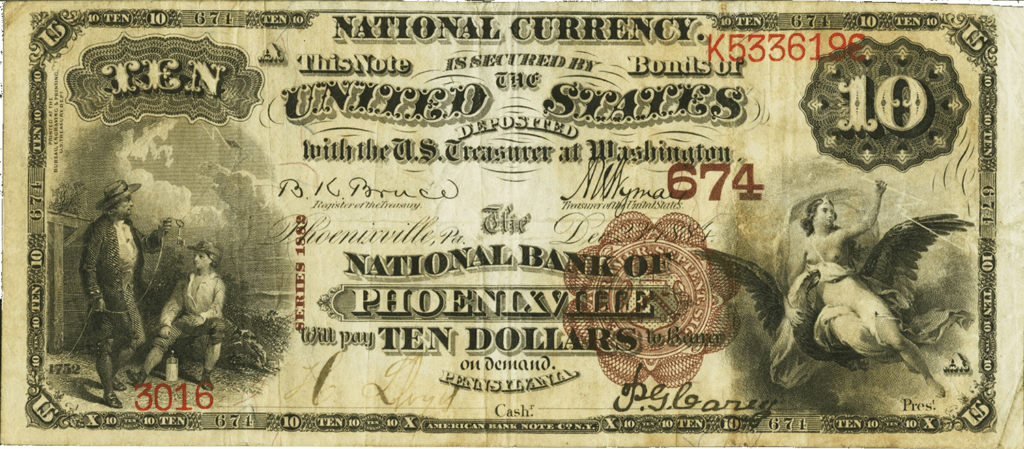
The National Bank of Phoenixville The National Banking Acts of 1863 and 1864 were two United States federal banking acts that established a system of National banks chartered at the federal level, and created the United States National Banking System. They encouraged development of a national currency backed by bank holdings of U.S. Treasury securities and established the Office of the Comptroller of the Currency as part of the United States Department of the Treasury. The Act shaped today’s national banking system and its support of a uniform U.S. banking policy. The Bank of Phoenixville transitioned to the chartered National Bank of Phoenixville in 1864 (#674). The note below is known or nicknamed a “Brown Back”, series of 1882, a large note and named for its ornate reverse which is mostly in brown (see below) from the second charter period, Act of 1882. This is a very scarce note and sold at auction in 2020 for $1200.
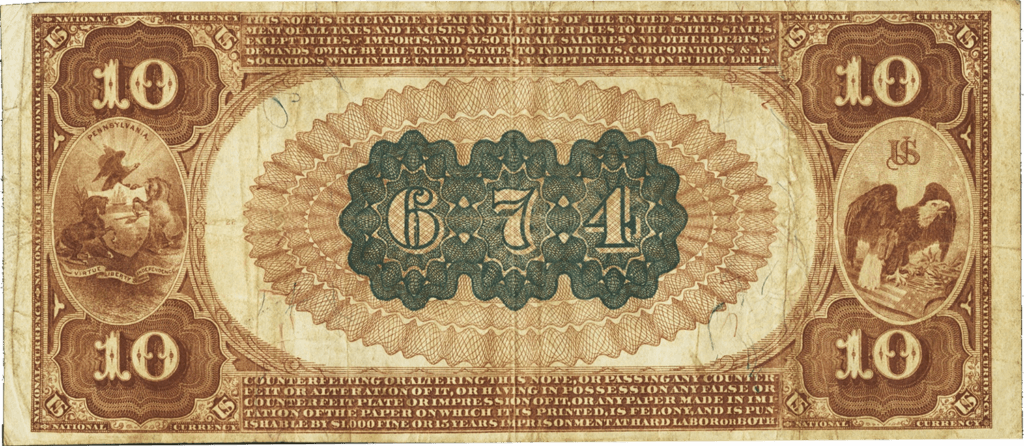
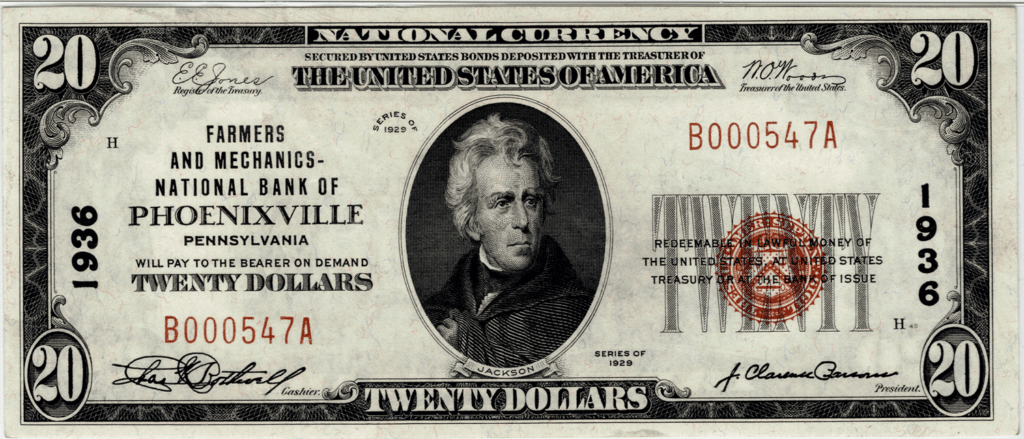
National Bank Note Era – 4th Charter Period July 1929 to May 1935, Farmers and Mechanics Bank of Phoenixville Pennsylvania
Another important financial institution in Phoenixville and possibly older was the Farmers and Mechanics National Bank.